
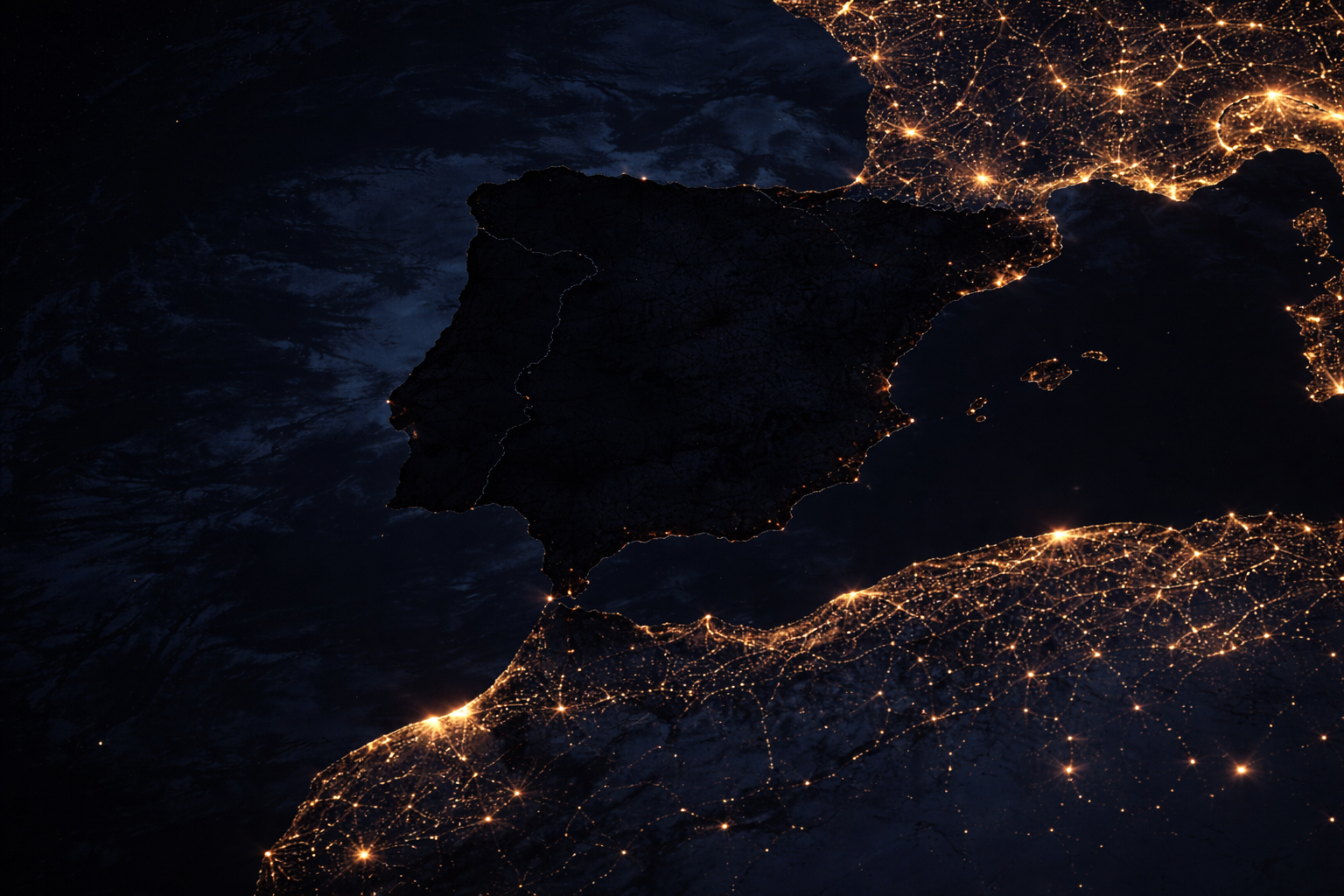
The Iberian blackout on Monday, April 28, 2025 reminds us of one thing: having continuous electricity is an engineering miracle!
Our neighbours lost 60% of demand (15 GW) in a few seconds. A brutal imbalance, followed by a domino effect until the blackout.
What is the cause of the power outage?
The main origin of the massive blackout that hit the Iberian Peninsula two months ago lies in an uncontrolled surge in the grid, combined with the failure of state-of-the-art power plants that are supposed to help stabilize the frequency around 50 Hz in the event of a fall or rise in grid tension. Indeed, for the network to function properly, it must maintain this balance between supply and demand at all times. Any significant variation, in particular a sudden drop in consumption or an excessive injection of energy, causes frequency imbalances.
In the Spanish case, the situation has been aggravated by the lack of adaptation of the network to the rapid increase in the share of intermittent renewable energies (solar and wind) in the electricity mix over the past several years. Spain has thus found itself with abundant renewable production but without the tools necessary to manage the sudden fluctuations in voltage and frequency that this generates. Thermal power plants, which traditionally play this “buffer” role, were neither sufficiently available nor properly mobilized to intervene in a timely manner.
How do electrical grids manage electricity losses?
To avoid such cuts, network operators such as RTE in France or Red Eléctrica de España (REE) use various tools. One of these is the capacity reserve, which is a production margin available at any time to compensate for a sudden imbalance.
More specifically:
- FCR (frequency containment reserve) or primary reserve to withstand the immediate shock.
- aFRR (automatic Frequency Restoration Reserve) or secondary reserve and the mFRR (specific manual Frequency Restoration Reserve) to restore the frequency and return to balance.
Flexibility as a solution to the reduction of inertia in networks linked to renewables
One of the challenges posed by renewable energies is the loss of inertia on the networks. Unlike the rotating machines of conventional power plants (coal, gas, nuclear), renewable installations (wind turbines, solar panels) are often connected via electronic converters that do not provide natural inertia. However, inertia is essential to dampen sudden frequency variations.
In this context, electrical flexibility is becoming a key complementary solution. It consists in modulating consumption in real time to rebalance the system. During excess production, some equipment may consume more (for example, temporarily overheating water), and conversely, in the event of tension on the network, non-priority consumption may be temporarily cut off. This reactivity contributes to stabilizing the frequency without the need for additional production resources such as advanced thermal power plants.
What conclusions can be drawn?
The blackout shows that a network highly dependent on intermittent energies requires sophisticated stabilization tools, rapid storage, and strengthened European connections.
The energy transition therefore requires an intelligent, responsive and resilient network, where each actor plays a role in the stability of the whole.
